
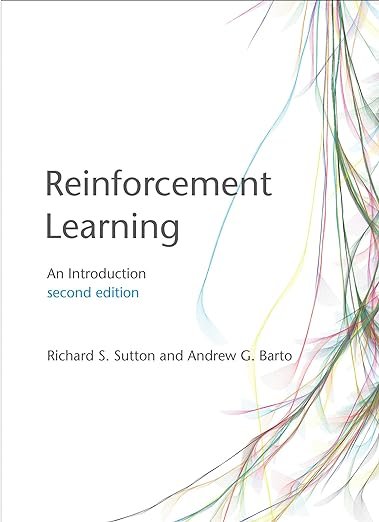
Professional and polished Reinforcement learning 2nd Edition is one of the most active areas of research in artificial intelligence, focusing on how agents learn to make decisions by interacting with complex, uncertain environments in order to maximize cumulative reward. Drawing on Reinforcement Learning by Richard Sutton and Andrew Barto, this course presents a clear and accessible introduction to the field’s foundational ideas and core algorithms, reflecting the expanded and updated second edition of the text.
The course emphasizes online learning methods, with mathematically intensive material clearly separated for focused study. Part I introduces reinforcement learning in the tabular setting, where exact solutions are possible, and includes key algorithms such as Upper Confidence Bound (UCB), Expected Sarsa, and Double Learning. Part II extends these concepts to function approximation, incorporating modern approaches such as artificial neural networks and related techniques.
More concise Reinforcement learning is a central area of artificial intelligence concerned with how agents learn through interaction with uncertain environments to maximize long-term reward. Based on the second edition of Sutton and Barto’s Reinforcement Learning, this course introduces the field’s core concepts and algorithms, emphasizing online learning methods.
Students begin with tabular methods and exact solution techniques, including UCB, Expected Sarsa, and Double Learning, before progressing to function approximation and modern approaches such as neural networks.
Slightly more student-friendly Reinforcement learning is a rapidly growing area of artificial intelligence that studies how agents learn optimal behavior through trial and error in complex environments. Using the updated second edition of Sutton and Barto’s Reinforcement Learning, this course provides a clear introduction to the field’s fundamental ideas, algorithms, and practical challenges.
The course first focuses on tabular methods and core online learning algorithms, then expands to function approximation techniques, including neural networks, highlighting how reinforcement learning scales to real-world problems.








Reviews
There are no reviews yet.